Our research
Chronic age-related diseases significantly impact quality of life and strains the public economy. Most chronic diseases can only be managed with lifelong treatments, while others remain untreatable. Recent advances suggest that systemic chronic inflammation, largely driven by the accumulation of senescent cells, plays a major role in the development of most chronic diseases. Soluble urokinase plasminogen activator receptor (suPAR), a key biomarker of chronic inflammation produced by senescent cells, correlates with disease severity and progression. Targeting senescent cells with senotherapeutic drugs to reduce inflammation—using suPAR as a new method for measuring this effect—offers a novel approach to managing and potentially preventing several age-related chronic diseases simultaneously.
We are a newly established lab conducting translational research from bench to bedside, integrating theory and methods from immunology, cell biology, epidemiology, and clinical research to study:
- Risk factors, novel biomarkers, and outcomes of systemic chronic inflammation and cellular senescence
- The inflammation markers suPAR and GDF15 in aging, health, and disease
- Mechanisms of inflammation and immune aging in vitro, in vivo, and in patient samples
- Interventions to reduce cellular senescence and systemic chronic inflammation to improve patient outcomes.
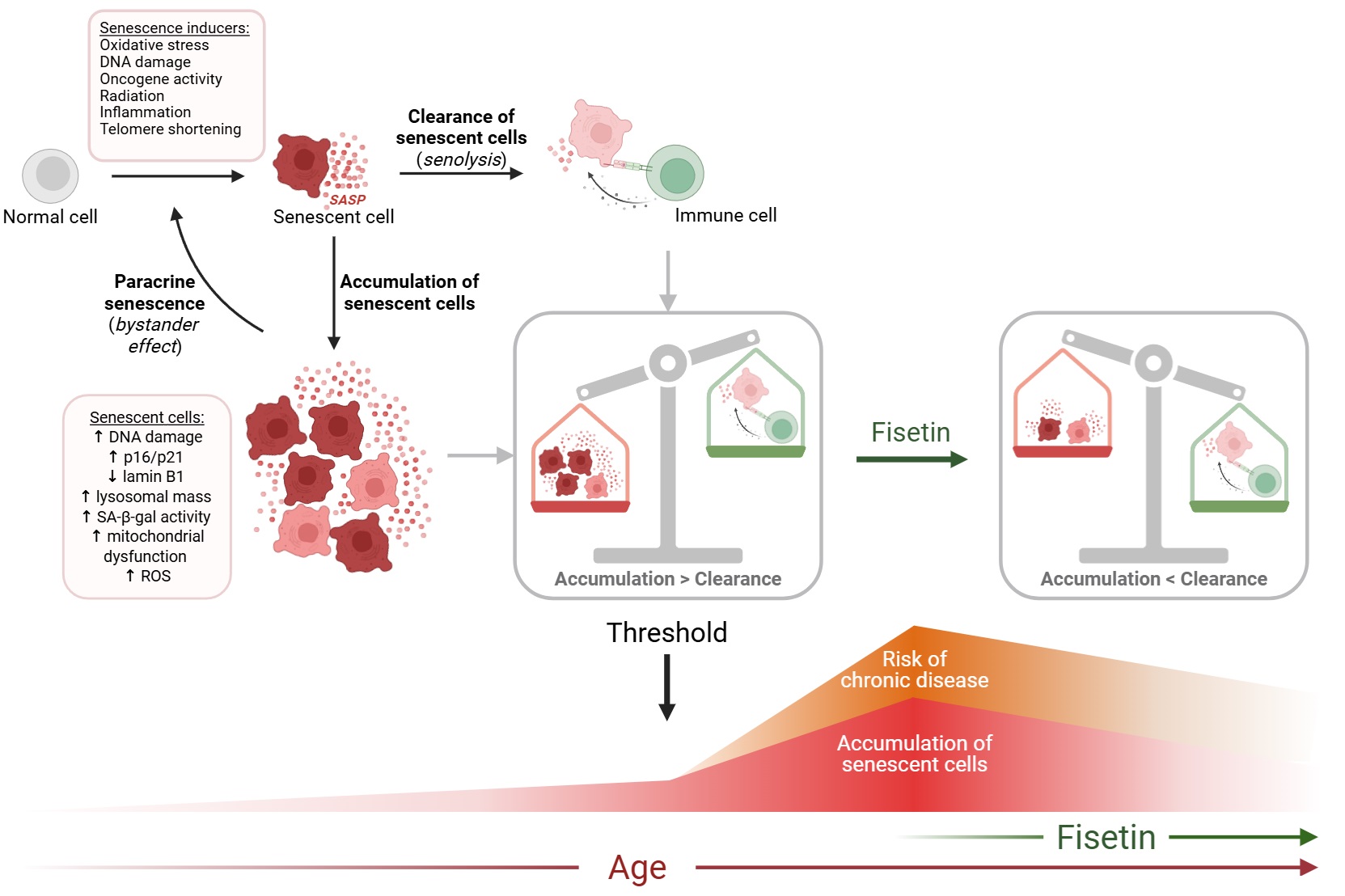 Senescent cell accumulation and the threshold theory. Intra- and extracellular stressors can induce cells to enter a state of cellular senescence characterized, among others, by stable cell cycle arrest, resistance to apoptosis, increased generation of reactive oxygen species, and the acquisition of a senescence-associated secretory phenotype (SASP). The SASP can in turn induce senescence locally in neighboring cells, through the “bystander effect”, but also in distant cells systemically. Senescent cells are generally subjected to immunosurveillance and cleared by immune cells in a process known as senolysis. However, when the rate of generation of new senescent cells reaches a threshold that exceeds the rate of clearance by immune cells, in part due to declining immune function, senescent cells accumulate in tissues. This contributes to organ and tissue dysfunction, potentially leading to the development of chronic diseases. Fisetin, as a potential senotherapeutic, could reduce senescent cell burden to a level where the immune system can again effectively control and prevent the accumulation of senescent cells, and thereby delay the onset and progression of chronic disease.Figure created with BioRender and modified from Tavenier et al., 2024, https://doi.org/10.1016/j.mad.2024.111995.
Mission and visionWe aim to generate critical new knowledge on inflammation and senescence in immune aging and disease development, by identifying key biomarkers and novel interventions that can be used to target these mechanisms. Our overall ambition is to promote the years lived free of disease and disability (extend healthspan) to improve quality of life for the individual in an increasingly longer life.
We are a young and highly collaborative team, where training and education of excellent researchers and producing scientific results of the highest quality are our top priorities. We are committed to the highest level of scientific rigor, integrity, and transparency as well as creating a supportive, inclusive, and diverse work environment.