The goal of rehabilitation 0-2 weeks after your surgery is to:
- Increase the range of motion in the knee.
- Activate the muscles around the knee and hip.
- Reduce pain and swelling.
- Be able to walk with crutches and manage daily activities.
- Optimize healing potential.
The primary healing in your knee occurs in the first 6 weeks after the arthroscopic surgery. Therefore, you have to follow the given instructions for optimal outcome.
The exercise programme should be performed three times a day and can be done approximately 30 minutes after taking pain-relieving medication. The programme should be followed for at least the first two weeks, or until your first visit to the physiotherapist after your surgery.
The exercises should be performed WITHOUT the brace, at a calm and controlled pace, and only up to the point of pain (pain threshold).
Instructions for using crutches
Use both crutches. Let both crutches follow the operated leg. You may want to take smaller steps at first, but try to walk as normally as possible. Weight-bearing is allowed up to the pain threshold.
When walking stairs, take one step at a time. Going upwards: Step up with the non-operated leg first. Going downwards: Step down with the operated leg first. Support yourself with the handrail using one hand and hold both crutches in the other hand. The crutches should follow the operated leg.
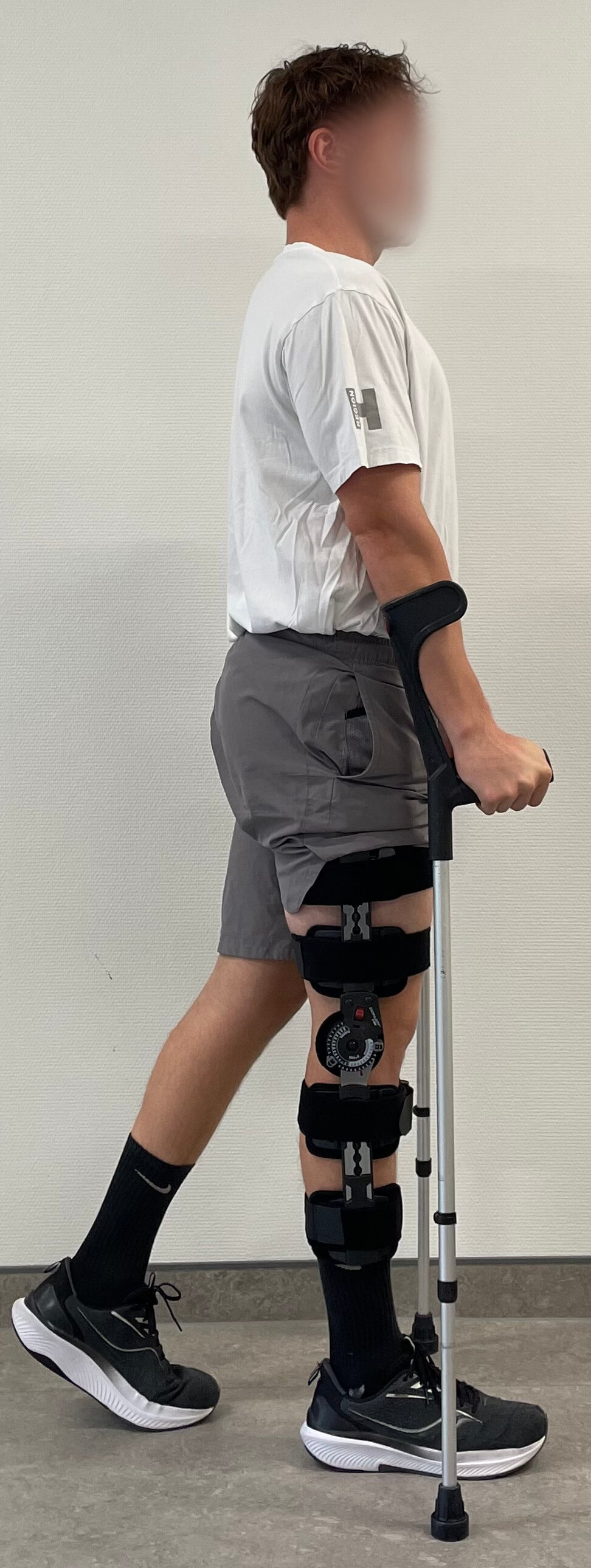
Stair walking
Up
Place the foot of the non-operated leg on the step, ensuring that your entire foot is on the step. Shift your weight to the healthy leg and push off, lifting the operated leg to meet the other, so both feet end up together on the same step. Move the crutches with the operated leg.
Down
Walk to the edge of the step. Place the crutches on the lower step. The operated leg follows the crutches down first, followed by the healthy leg. Shift your weight onto the crutches to reduce the weight on the operated leg.
Control pain and swelling
Following the advice below will help prevent and reduce pain and swelling:
- Minimize walking to reduce load on the knee. Use crutches when necessary
- In rest elevate the leg and perform calf pump exercises regularly.
- If necessary, apply an ice pack to the knee (e.g., a bag of frozen peas). Do not ice for more than 20 minutes at a time. You can also use ice after training. Place a thin towel or similar between your knee and the ice pack.
Resting position
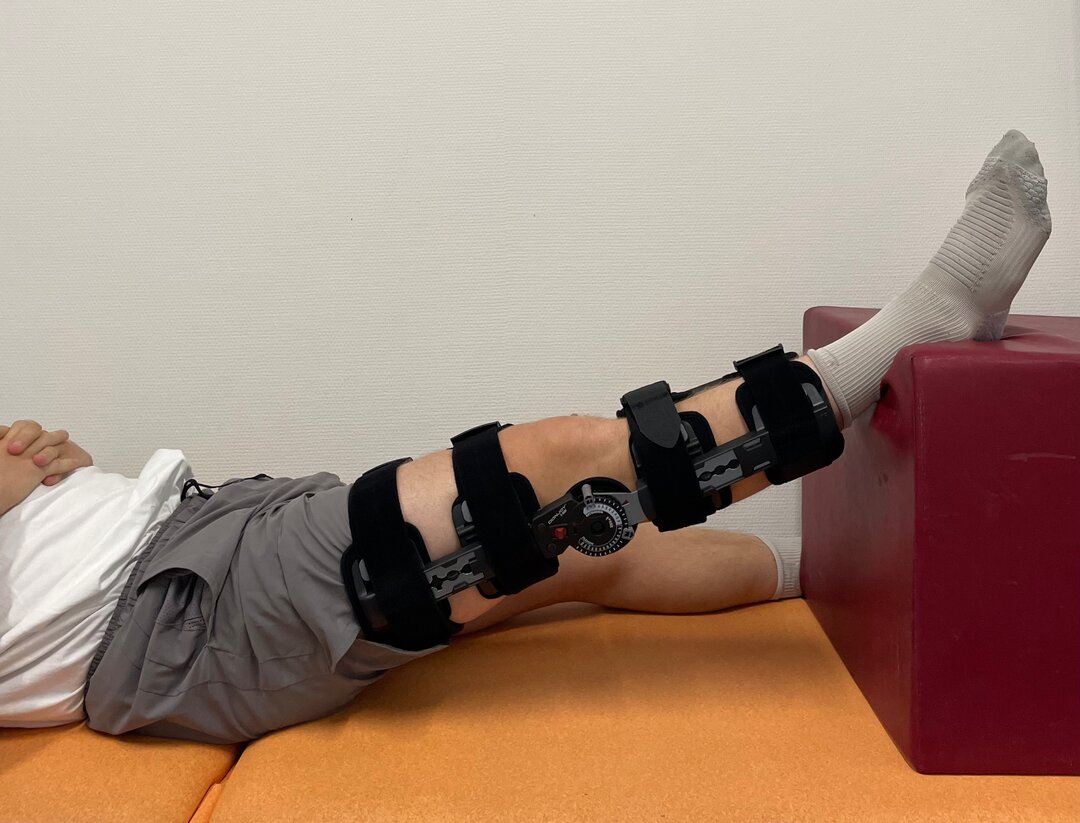
Lie flat on your back with or without a pillow for relaxing back and neck. Keep the leg straight and raised above heart level, for reduced swelling.
Don-Joy
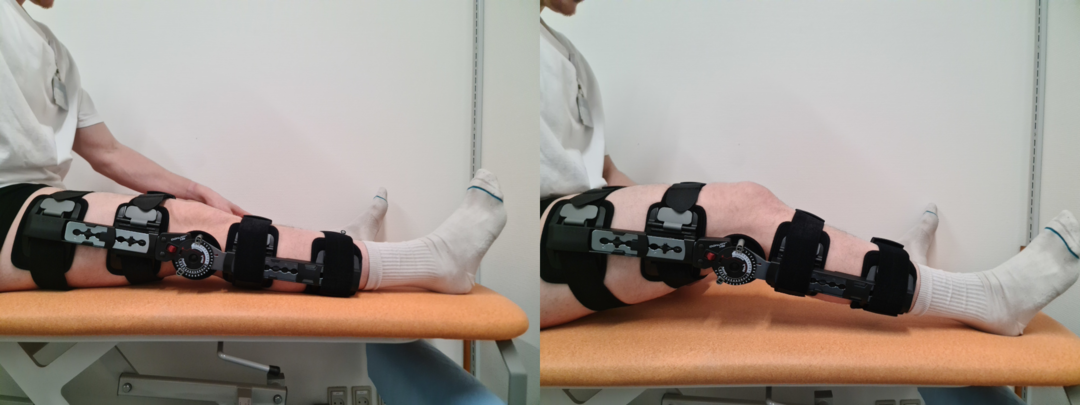 Straight = Correct fixation
Bent = Incorrect fixation
If you have been fitted with a DonJoy brace after your surgery, it is important that it is properly adjusted. The metal splints should run parallel along the leg, and the straps should be tight enough to keep the leg in a straight position. The brace should be positioned directly at the side of the knee joint. The DonJoy brace can be removed during exercise and when taking a bath. While in the bath, you must keep the leg straight.
Exercises
3 x daily
1. Dynamic warm-up on roller
Sit or lie on the floor. Use either a foam roller or a rolled-up towel. Place the roller/towel under the knee joint. Point your foot upwards and straighten the knee. The knee should remain in contact with the roller/towel throughout the movement. Stretch and bend the knee rhythmically to create a pumping effect. If the exercise cannot be performed with the roller under the knee joint, you can move the roller further down the calf to make it easier to straighten the leg. Perform for about 5 minutes, with the possibility of short breaks.
2. Knee extension on roller
Start in the same position as the previous exercise.
Lift your lower leg and fully straighten the knee.
Hold the position for 5-10 seconds, then slowly lower the leg.
Repeat 10-15 times.
3. Tightening of thigh muscle
Sit or lie on the floor with your legs straight along the surface. Straighten the knee by tightening the thigh muscle, pressing the back of your knee against the floor so that your heel lifts off the floor.
Hold the tension for 5-10 seconds, then relax.
Repeat 10-15 times.
4. Knee bending and straightening – On floor
Sit or lie on the floor, supporting yourself with your arms.
Bend the knee and let the foot glide backward and forward along the surface.
Hold the bent position for about 10 seconds.
If you have had your meniscus repaired, do not bend the knee past 90°.
Repeat 10-15 times.
5. Knee bending and straightening - Seated on a chair
Sit on the edge of a chair or similar with the knee straight and the foot on a piece of plastic or cloth so it can slide. Bend the knee and let the foot glide along the surface and straighten again.
Hold the outer positions for about 10 seconds.
If you have had your meniscus sewn, do not bend the knee past 90°.
Perform with 10-15 repetitions.
6. Prone diagonal lift (performed on both legs)
Lie flat on your stomach with your arms extended above your head. Lift one arm and the opposite leg straight up from the floor, and then slowly lower them again. Lift then the opposite arm and leg.
Perform with 10-20 repetitions and preferably 3-5 sets.
7. Side-lying single-leg lift of the upper leg (performed on both legs)
Lie on your side with the operated leg on top.
Lift the operated leg slowly upwards and backward, and lower it in a controlled motion.
Keep the hip extended throughout the movement.
Perform with 10-20 repetitions and preferably 3-5 sets.
8. Side-lying single-leg lift of the lower leg (performed on both legs)
Lie on your side with the operated leg at the bottom and the non-operated leg bent in front.
Lift the operated leg straight up and down with a slow, controlled movement.
Perform with 10-20 repetitions and preferably 3-5 sets.
Get the information on your phone
 Scan the QR code and get the information on your phone.