Aims of Rehabilitation in Phase 1
During the first six weeks following your shoulder arthroscopy, the primary aims of rehabilitation are to:
- Maintain and improve mobility in the shoulder.
- Reduction of pain and swelling
- Protect the operated structure.
Following arthroscopic surgery, the most important phase of structures healing occurs within the first six weeks. Therefore, it is essential to follow the given instructions and adhere to the restrictions.
Your exercise programme should be performed two to three times daily, preferably approximately 30 minutes after taking pain relief medication. This programme ought to be continued for at least the first two weeks or until you attend your first review with your physiotherapist. Do all exercises without wearing your arm sling, move slowly and gently, and stop if you feel pain.
How to Reduce Pain and Swelling
Following the recommendations below will help to minimise pain and swelling:
- Rest your shoulder by wearing the sling correctly and/or supporting with a pillow as instructed. Your shoulder should be able to relax if it has the right amount of support.
- You may apply ice to the shoulder (for example, a bag of frozen peas) for a maximum of 20 minutes at a time. This can be repeated after exercising if required.
Always place a towel or similar fabric between your skin and the ice pack. - Keep taking your prescribed pain relief medicine regularly for 10 to 14 days after the operation. The painkillers help reduce both the pain and the swelling. We recommend continuing to take them even if the pain has lessened.
- Remain physically active, such as by walking or cycling on an exercise bike for general fitness. Do not use your operated arm for support.
Resting Positions
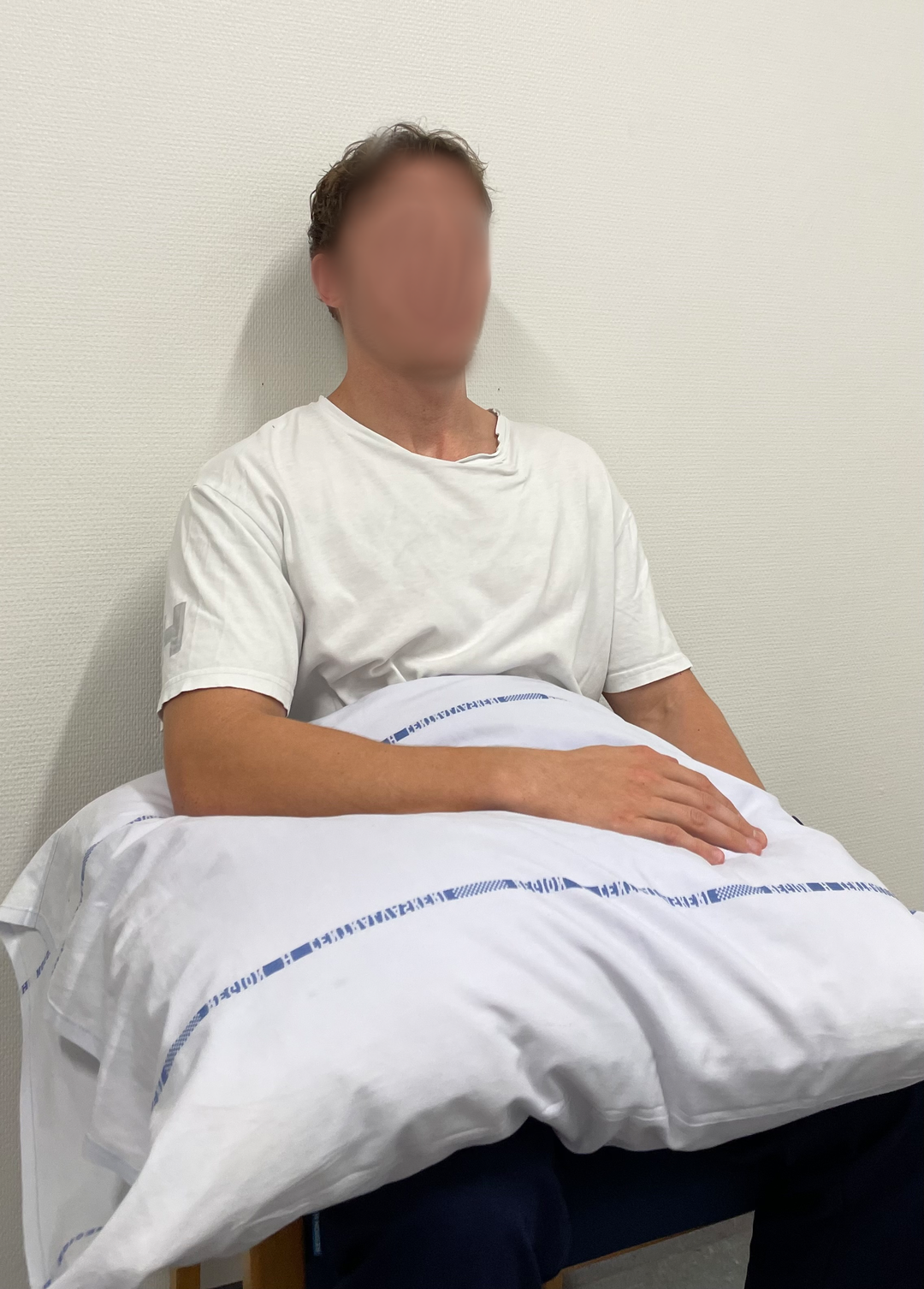
If you are sitting down, you can loosen your sling and rest your forearm on a pillow under your arm. Make sure that your arm does not rest above 45 degrees of elevation.
Movement Restrictions - Following Repair of the Labrum or Tendon
If you have had repair of the shoulder labrum or tendon:
- You may move your arm forwards or sideways to no more than 45 degrees of elevation (applies to Exercises 4 and 5).
- You may rotate your arm outwards (external rotation) to no more than 20 degrees after labrum repair, or up to 45 degrees after tendon repair (applies to Exercise 6).
If your surgical report states that no restrictions apply, you may move your shoulder freely within pain limits. If uncertain, please contact the Physiotherapy and Occupational Therapy Department on 38 62 22 32 (Monday–Friday, 08:00–15:00).
Exercise Programme – Initial Phase (Phase 1)
Exercise 1: Shoulder Blade Control (scapulair control)
- Sit upright on a chair with relaxed shoulders.
- Try to draw your shoulder blades together without raising or lowering your shoulders.
- Complete 10–15 repetitions for 2–3 sets, three times daily.
Exercise 2: Venous Pump (Hand Opening/Closing)
- Close your hand into a fist, then open the hand fully and spread the fingers.
- Complete 30 repetitions, 3–5 times daily.
Exercise 3: Elbow Flexion and Extension
- Bend your arm at the elbow as to the endrange (as far as you natural can).
If unable to do so actively, assist the movement with your opposite hand. - Fully extend both the elbow and the fingers.
- Complete 20–30 repetitions, 3–5 times daily.
Exercise 4: Forward Elevation of the Arm
- Sit at a table and rest your arm on a cloth or plastic sheet.
- Use your unoperated arm to help move the operated arm forwards and back to the starting position, allowing your upper body to follow the movement.
- Please observe movement restrictions as described above (max 45 degrees).
- Complete 10 repetitions, three times daily.
Exercise 5: Sideways Elevation of the Arm
- Sit at a table and rest your arm on a cloth or plastic sheet.
- Use your unoperated arm to guide the operated arm out to the side, away from the body, and return to the starting position.
- Observe movement restrictions.
- Complete 10 repetitions, three times daily.
Exercise 6: External Rotation of the Arm
- Sit at a table and rest your arm on a cloth or plastic sheet.
- Use your unoperated arm to guide the operated arm out in rotation, keeping the elbow close to your side. You may use an aid, like a stick or wooden spoon, to assist.
- Observe movement restrictions as detailed above.
- Complete 10 repetitions, three times daily.
Should you have any uncertainties or concerns about your exercise programme or movement restrictions, please contact your physiotherapy team for guidance.
Get the information on your phone
 Scan the QR code and get the information on your phone.